In the fall of 2025 Monte Clark launched a new gallery space on 1st Avenue with a show of new paintings by Graham Gillmore, a name familiar to those who’ve tracked the careers of Vancouver’s celebrated art exports over the past few decades. The show was titled “Behold And Be A Genius!” after a keystone painting in the collection and it provided a welcome and all-too-rare opportunity to see Graham’s work in person.
If you were around in Vancouver during the eighties you may recall the infamous Warehouse Show of 1984, a kind of Salon des Refusés mega-show that was, in turn, a response to a 1983 survey of contemporary west coast art at the Vancouver Art Gallery that was perceived as being exclusive of emerging local talents. Among many others it included new works by an ambitious and spectacularly talented group of young painters that would soon “break big”; Derek Root, Angela Grossman, Philippe Raphanel, Vicky Marshall, Charles Rea, Attilla Richard Lukacs, Mina Totino and Graham Gillmore. The next year their work comprised the “Young Romantics” show at the Vancouver Art Gallery, a well-reviewed local blockbuster exhibit which launched them on career trajectories that continue to flourish to this day.
In 1984 I was taking my first art history courses and was full of excitement for the future of our local art scene, though I had no idea where I might fit in. It seemed like a fresh inflection point and I was taking notes. Graham Gillmore’s work emerged as a personal favourite because of my fondness for wry wordplay and despite that decade’s enthusiasm for text based art (Jenny Holzer et al), it managed to stand out as wholly original, even with a knowledge of the antecedents and influences (from Picasso through Ruscha, Basquiat et al). It struck me as original, beautiful and funny. A complete trifecta in my world!
But Graham soon moved to New York and local shows of his paintings became few and far between. With the internet age and his eventual relocation to the BC interior hamlet of Winlaw, I began looking for his work online and was pleasantly surprised that it retained its freshness for me. The wordplay remains unpredictable and the painting as seductive as ever. I also realized his work had been an influence on my own photography. Only recently did I realize that I’d been applying deliberate misspellings, applying fragments of song lyrics and half-memorized aphorisms and such to my improvised still lifes with his work, at least partly, in mind.
Like a great piece of music, a successful painting invites repeated visits, and will reveal new things to (and about) the viewer over time. Some of Graham’s very large and densely packed works are loaded with potential readings. However, most of us get only one viewing at a gallery opening before the work is off to a private space. His work has not generally been shown in public institutions.
In advance of the show, I went down the internet rabbit hole looking at work from the last forty years. It was a joy to rediscover what I’ve always loved about his paintings. Almost at random I found “Leading Lady”, a large scale piece from the mid-90s that exemplified what I feel to be almost a signature work, though there are now many “signatures” to explore, many of which I’d missed over the years.
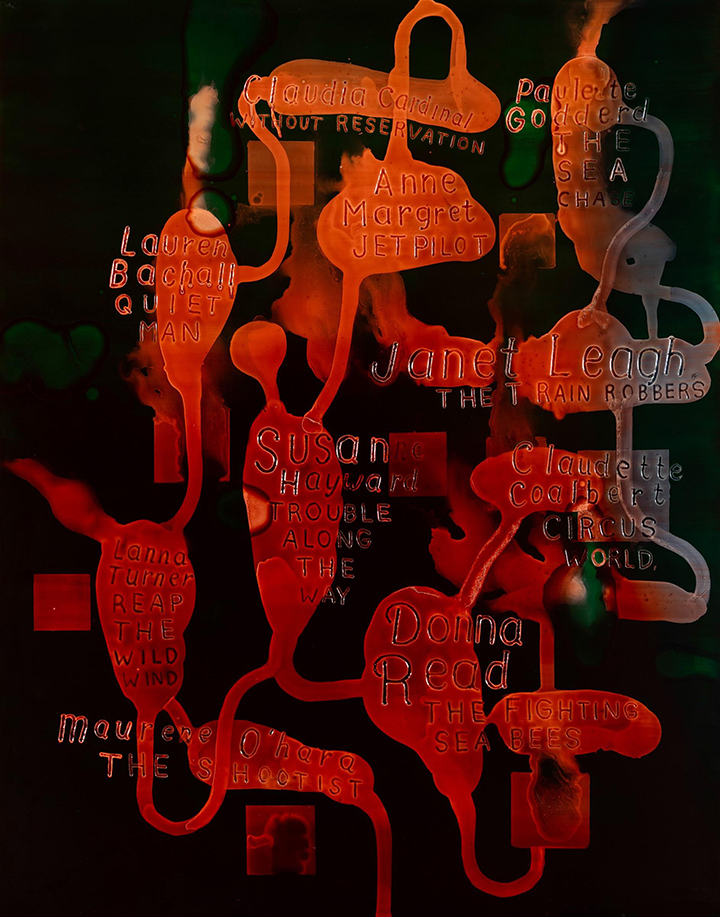
Leading Lady, 1997
“Leading Lady” pairs the names of long-passed Hollywood screen sirens and films I thought they starred in, embedded in connected blood-red forms resembling both speech balloons and human organs. It sets the viewer up for a multitude of associative takes. And I say “I thought” because once I noticed the misspellings of some of their names, I decided to double check the stories surrounding the films. It turns out that none of the actors appeared in the films their names appear with. But there are connective tissues which you’ll only discover with some research that will show how the pairings are quite deliberate. Given that by the mid-90s, when it was painted, these stars’ names would already have been a distant memory recognized mostly by a generation that had already passed, it may even partly be a play on how easy it is to fudge historical fact itself.
So you see what I mean. You can keep coming back to these paintings and expand your interest as much as you like. They are whimsical, ironic, and occasionally contain deep dive references to political or entertainment histories. Or perhaps they’ll evoke fugitive memories of long forgotten notes you once wrote to yourself in the margins of a book…or a shopping list embellished with amorphous red and blue ballpoint text balloons. In any event you will never look at the written word the same again, particularly in vernacular forms.
Some larger paintings function a bit like busy, large scale cartoon panels with the characters stripped away. I’m never sure whether they’re meant to be read up or down, backwards or diagonally. The first impact is as a “painting” then the brain hones in and switches gears to parse the text and start making sense. It can feel like an endless loop. But it’s a fun place to hang out for awhile like inhabiting a woozy word game that is out to trick and amuse you.
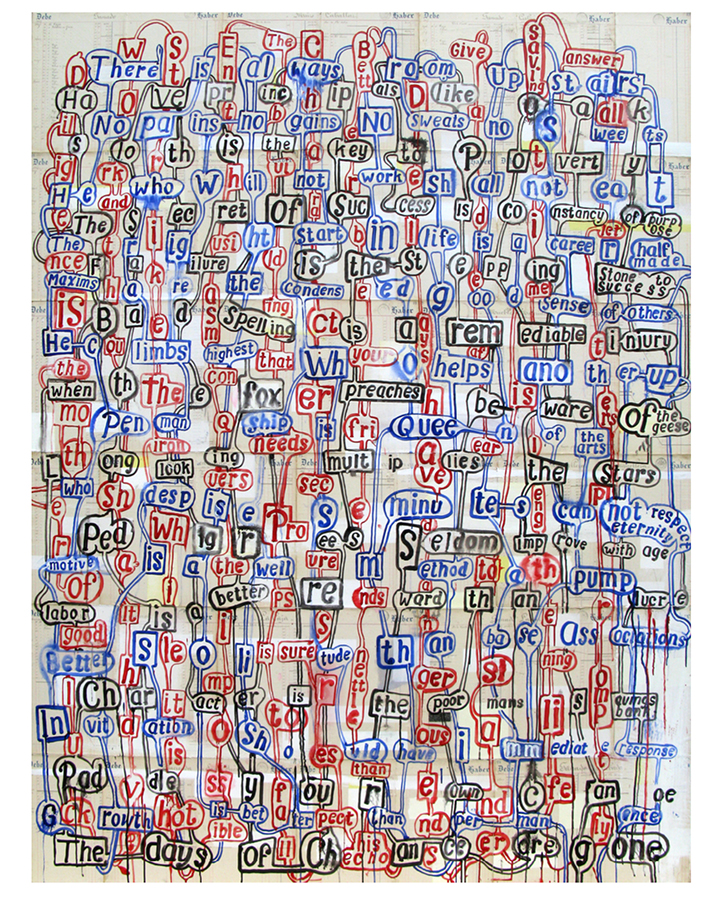
Penmanship is Queen of the Arts, 2002
With the smaller works, the swordplay is more economical (Ed note: I am not correcting this genuinely accidental misspelling of “wordplay” for what I hope are obvious reasons!) Sometimes the text consists of only two words. There is often a quick, satisfying flash of recognition and amusement.
Like many, I have an inner voice when reading text. With the smaller paintings that voice lasts only as long as it takes to read the text once. But seeing as we generally have no inner voice when looking at purely abstract or figurative painting, I wonder if part of the attraction to this work is experiencing an initial burst of recognition followed by a longer, more contemplative phase of viewing. Perhaps, like Flavour Burst (TM) gum, these confections suddenly get sweeter or surprise you with an unexpected taste the longer you chew on them.
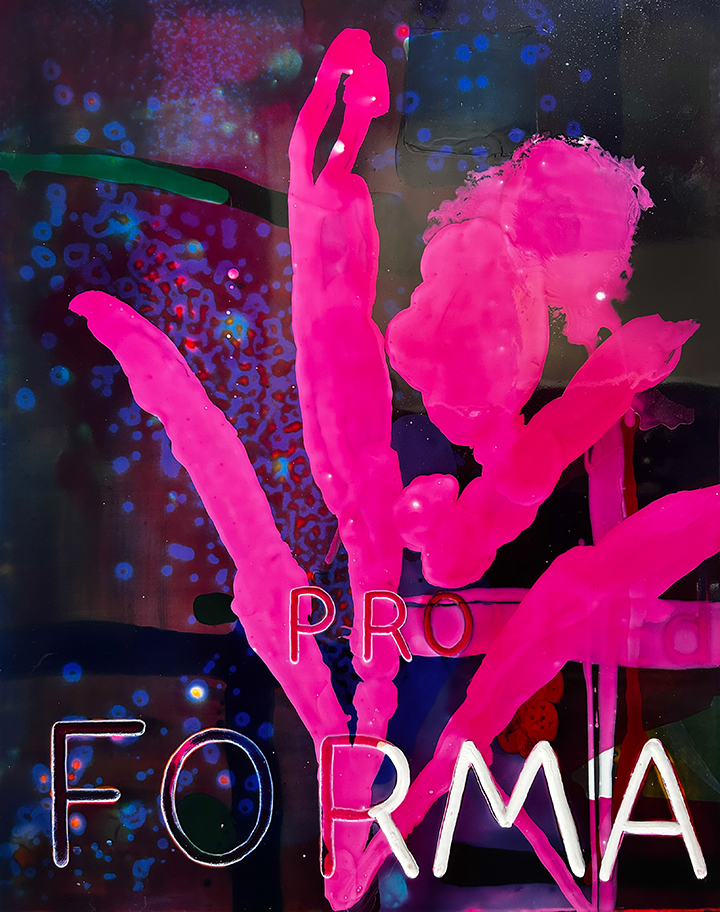
Pro Forma, 2025
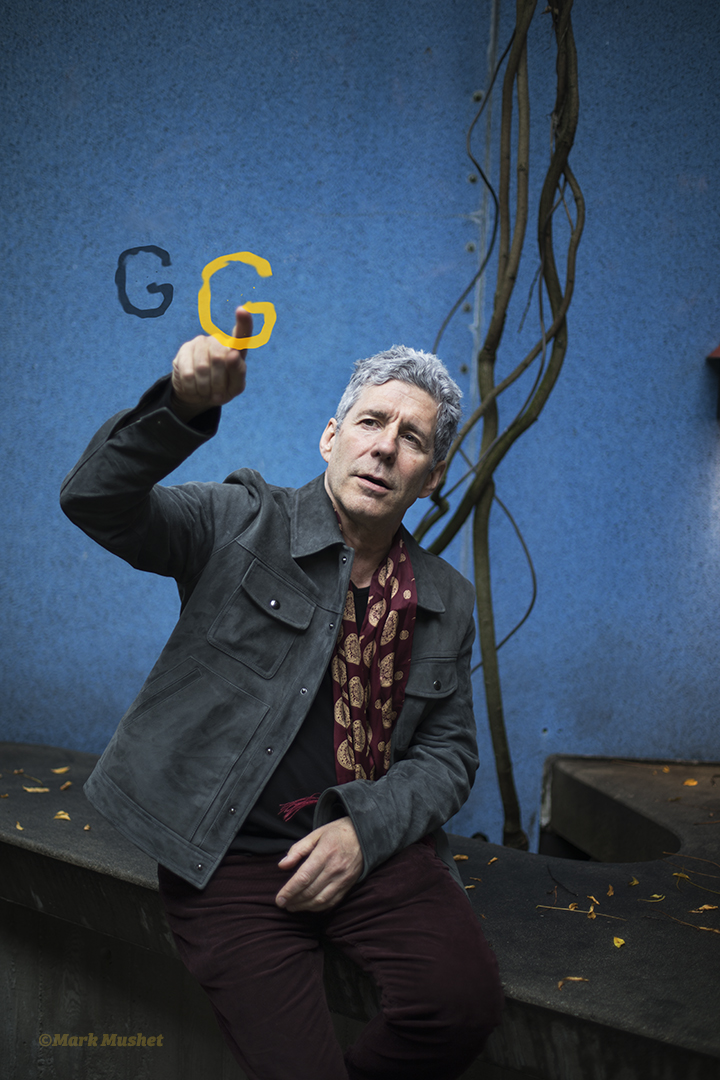
In any event, Graham’s opening presented an opportunity to finally meet, do a portrait or two, and get a discussion going. We spoke in person, by phone and by e-mail while both of us were navigating some of life’s classic, mid-life vicissitudes over the winter. The portraits were improvised in proximity to the gallery and the choice to juxtapose two of them with current works in this article was spurred by the sympathetic palette and tone I saw in them afterwards. How does that work? In any event, it’s been a pleasure! So…herewith:
MM: I first saw your work around the time local critics were using the term “Young Romantics” to try and ‘brand’ a group of you. The term seems quaint now.
GG: ‘Young Romantics’ was the title of a group exhibition at the Vancouver Art Gallery in 1985. It was actually coined by Scott Watson, the curator at the time. I guess he was making a connection with our expressionistic work and the Romantic movement in Europe. But we were too busy making art to think about individualism and the sublime aspects of nature! There was a review for the exhibition in Vanguard magazine. Referencing the poetry of John Keats, it mentioned that my paintings were involved with sensation rather than thought. Ouch.
MM: I was researching some early interviews you’ve done and one quote stuck out that I wanted to ask about:
“All this manic scratching relates back to my childhood when I was obsessed with carving GG loves ‘XX’ into the bark of Maple trees in my back yard, a proclamation that still rings true.”
That put me in mind of the extensive use of the term “mark making” in art discourse these days. Well, of course we’re always “mark making” on some level! But what for?
GG: Regarding carving initials into trees when I was a kid: It was my subconscious hope, call it wish fulfillment, that by committing this act of naming, my object of desire could somehow make it true. To whom was a speaking? To myself, and to the person whose name begins with those initials, but mostly I was speaking to the cosmos. This holds true today. Boil it down and you are left with affairs of the heart.
MM: I’ve always been interested in the ways in which the brain processes letters and words to distill meaning and intent when there are clearly accidental or deliberate letter spacing/leading aberrations, or where letters are reversed. We seem able to quickly grasp popular phrases and expressions (and their sentiments) if we’ve had enough repeated exposure to them even when they are presented to us in re-ordered fragments. There is a degree of “automation” that occurs. Does your work seek to short circuit this process or merely use it in an intuitive way?
GG: I am not a linguist or a semanticist, obviously. I happen to make images with words in them. I remember getting grilled by my instructors in art school who accused me of being irresponsible or ignorant of the signification of language. It was as though I wasn’t qualified to delve into this rarefied domain. But my instructors missed the point: painting is about freedom, and the pursuit of pleasure. A poet doesn’t require a degree in semiology. A musician can move the listener to tears without knowing how to read or write a score. But trouble is brewing if a painter explores the poetics of the written word! At least that’s how I saw it when I was starting out. I wanted something more than a purely formalistic, abstract painting. Historically, that ship has sailed. So, by using the visible word, I have the freedom to paint like Rothko, or Morris Louis, but still tell a story.
MM: Surely now the compression of nearly everything into internet acronym or generational “in joke” has had an impact. Audiences for language use must surely be fracturing. Are you adapting? Or can you find a way to paint “six seven”? 😉
GG: I don’t think about trendy slang, like ‘six-seven’. If I did, my work would become obsolete in a few weeks. I leave that to pop music. On the other hand, this reminds me of Howard Bloom saying that Harry Potter was a passing fad because it didn’t offer any lasting contribution to literature!
MM: I increasingly notice that when typing, I tend to switch one letter for another. It could be caused by many things. I never learned to type and I think it’s pretty common. But I even refer to my girlfriend now as Wnedy because I spell it that way so often!
GG: Wnedy- That’s funny. I will often sign off on an email with the word ‘thnaks’ rather than ‘thanks’ for the same reason. I’ve even gone so far as to misspell my own name. (Gilmour, Glimmer). It was liberating. Like a transparent alias. Other examples come to mind: It was necessary to spell opportunist with one P in the piece “Op or Tunist’ to maintain the absurd word play. The ‘My Influenza’ series from the 90’s (the title itself is a play on my ‘influences’) was based on spelling the names of great philosophers phonetically. This act of mis-authorship undermines the elitism of certain fields of knowledge. It’s punk rock.
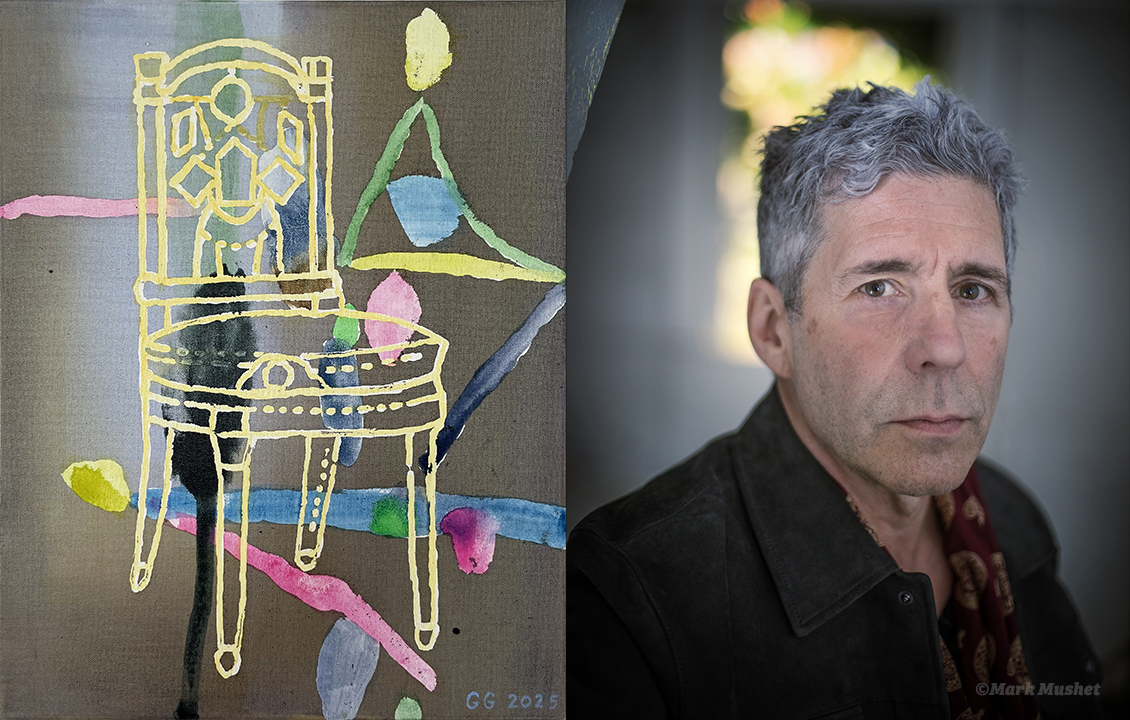
Dethroned, 2025 (+ portrait 2025)
MM: Our mutual acquaintance Neil Wedman once told me that artists (largely meaning painters with commercial gallery representation) are just producing trinkets for the 1%. Of course that came with a laugh but there’s a large grain of truth there. Not that I expect you to be painting time-stamped sociopolitical commentary, but things are pretty extreme at the moment.
GG: At the end of the day, most contemporary abstract painting is a form of entertainment. There are better mediums to talk about social change. The novelist George Packer tells us that we shouldn’t expect to change the world. Witnessing, recording, protesting, affirming should be enough. I like to think that when someone takes in one of my paintings, they don’t the need Coles Notes. The viewer should be moved by direct experience with the painting.
MM: Fun fact! We are the same age, born in the same hospital in the same year. We grew up in North/West Vancouver and are *cusp* Gen-Xers who’ve travelled in overlapping circles for decades.
GG: That’s true! Do you remember who delivered you, Mark? Now that would be remarkable. You have my mother’s eyes…Maybe we were switched at birth.
(Ed. note: I most definitely have my mother’s eyes as we were navigating cataract surgeries simultaneously while I was putting this piece together!)
MM: Does anything of this place still find a place in your work? Or your way of working?
GG: I’m not supposed to admit it, but painting is a form of therapy for me. I started painting when I was 6. The world was a scary place. Now, more so. I was able to avoid pain through painting. This holds true today.
MM: And the natural world? It was a pretty magnificent place to grow up. Ours is a pretty exotic environment to be steeped in.
GG: My dad had a sailboat when I was a kid. We explored the waters of the Pacific Northwest on our Summer holidays. I think this is where I get my sense of colour. I would spend hours with my head hanging over the side of the boat, looking at the water and the way the light was reflected on its surface. And then there’s a mystery in gazing down into the murky depths – something unknowable beneath the surface. This sensation still influences my work.
MM: In the early and mid 80s I felt the city would soon reach a cultural critical mass in my working lifetime so I never felt the urge to leave but you split for the obvious epicentre of the North American art world, New York in 1986, the year after the VAG show. What happened?
GG: There was a radical shift in my life when I moved to NYC. I went from the edge of the world to the center of the universe. Everything changed. The Lower East Side in the eighties was beyond anything I will experience again. I grew up in West Vancouver in the 1970’s. There was one Asian kid in my high school. Henry was cool. But Downtown Manhattan was mind blowing. I caught the tail end of a radical cultural moment which I think about every day. I smoked dope with Basquiat, had an amorous moment with Grace Jones in an elevator and shared a bagel with Allen Ginsberg. My first studio was a fish smoking factory near Tomkins Square Park. My band used to practice in the basement of CBGB’s. Hilly, the owner, was our manager. I made some mistakes. Then I got down to work.
MM: What role did music play? I have always loved music and even found my way to some art through musical references.
GG: My formative years in grade school were not heavily influenced by the culture of my generation. From what I remember, I was kind of a loner. And then I discovered music. My neighbour’s band rehearsed in his parents’ garage. I must have been around ten years old. I could hear them at night from my bedroom. Sneaking out through my window, I would hop the fence and watch them play. They let me just sit there on the floor for hours. Frank Zappa, King Crimson, Captain Beefheart – stuff like that. Pretty heady stuff for a kid! I was hooked. Soon, I was playing in my own band. I got into hardcore and punk rock in my 20’s when I moved to NYC. Which is weird, because most musicians get that style of music out of their system first, and the move on to Jazz and Prog rock!
MM: How do you relate your work to concrete poetry. I imagine there’s a relationship there.
GG: Concrete poetry gave me the green light to use language on a purely visual level. But is that even possible? Ever since Apollinaire, we have been trying to pound a wedge between a word its meaning. Remember that game where you repeat a word over and over again until it loses its meaning? It just becomes a sound. The best concrete poems are in Italian, which makes them even better because I don’t speak Italian.
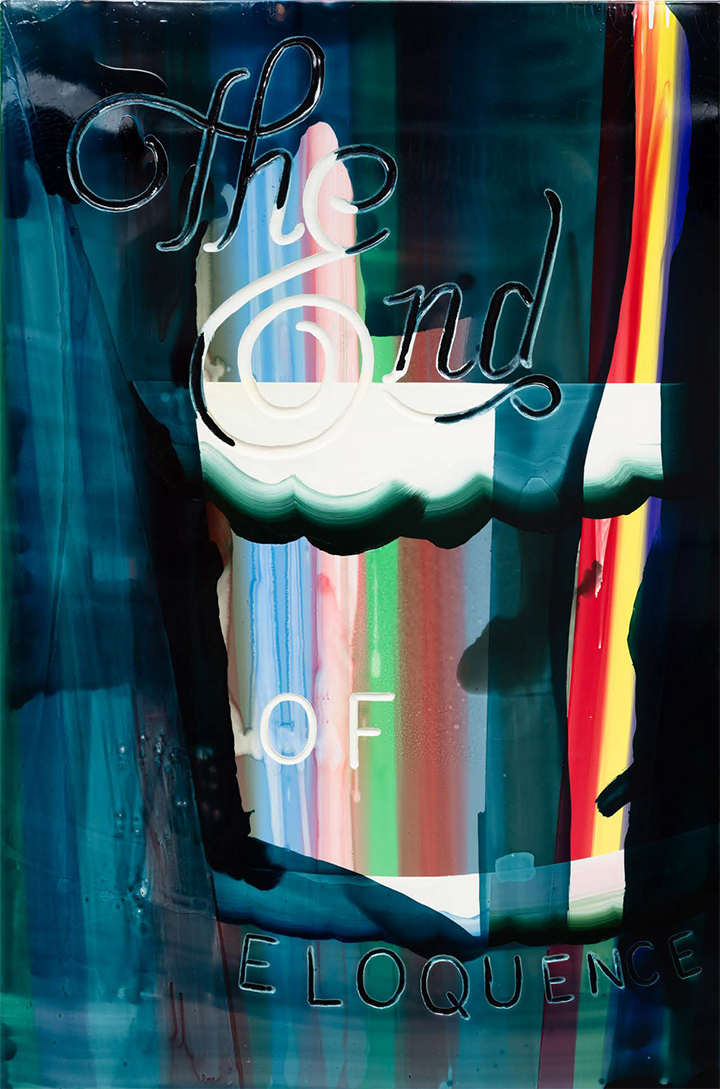
The End of Eloquence, 2020
MM: You’re working more with canvas and acrylics now. I always think of your texts as being embedded, “hewn” with a router. And fugitive in some ways. Now the words sit more obviously on the surface. And I love what you once said that “texts are “linguistic ‘roadkill’, skeletons on which to hang the material of the painting.”
GG: My first paintings were on canvas using conventional materials. The engraved panels actually came later. The act of carving out the letters was so powerful – even violent; language is transient – metaphysical and I discovered that through the act of gouging out the text, I was turning the cognitive realm into the physical one. Isn’t that what painting does best?
MM: You’ve gone from Vancouver to New York, then to Winlaw and finally, now, Belleville, Ontario. Have the moves between urban and rural environments had an impact on your work?
GG: I’ve had studios in both urban and rural places. It’s strange – in the city, my paintings are often influenced by nature, and when I’m surrounded by forest, the work can take on a more urbane quality. This suggests to me that it’s more about the memory of a place than actually experiencing it in the moment.
Ideas take time to gestate. Any thinker will tell you that. Most ideas are stupid. Sometimes, just as in life, losing hope is the best thing that can happen. If you think it’s a failure, you put it away, the painting is lost. You forget about it. And then you come across it five years later and know exactly how to make it whole. Some paintings, however, are irredeemable. I set those ones on fire in my backyard. You should see all the pretty colours in the smoke as the paint melts and then goes up in flames.
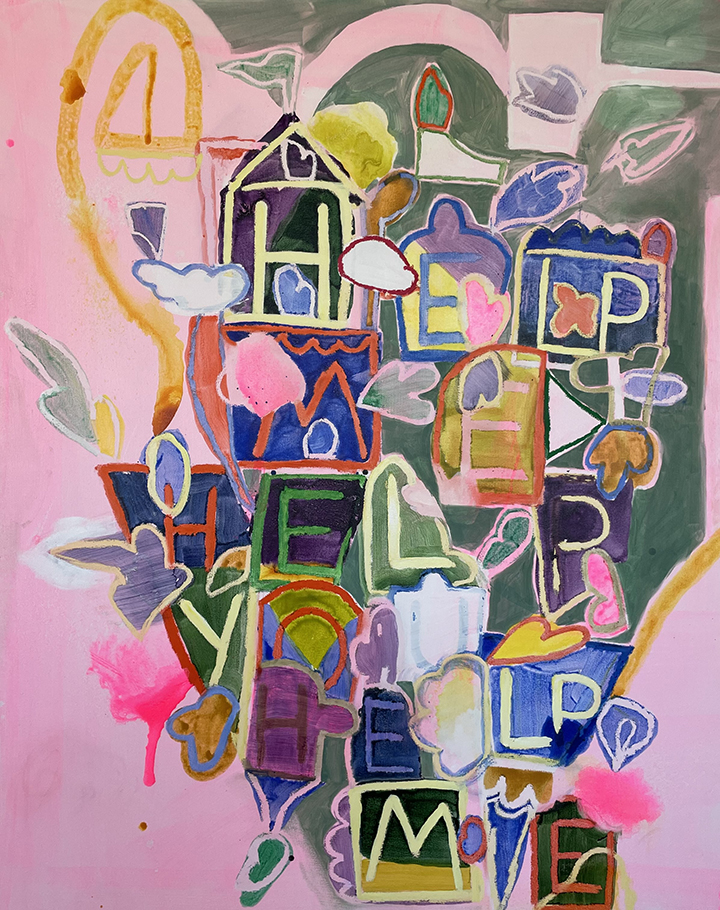
I Want You to Help Me Help You Help Me, 2023
MM: There’s so much art and…not art that has really watered down the impact of text in painting. I still enjoy the wit and twists of meaning you employ.
GG: A major concern I have with putting images and ideas out into the world is that they may be taken as being irrelevant, or worse, boring. But I rely on my conviction that if I’m being sincere, I will tap into other people’s experience of what it’s like to be human. On the other hand, a lot of the language I have used over the years plays with self-deprecation, jokes, irony, poking holes in highbrow subjects. So, in a way, I’m shooting myself in the foot. The vacillation between sincerity and wit interests me. My first review in NYC mentioned that ‘… the painting’s pathos is swimming in its own bathos.’ I liked that.
Here are a few examples of how manipulating language can create unexpected results:
“The importance of being Earnest” (Wilde) becomes “The earnestness of being imported”.
“Civilization and it’s discontents” (Freud) becomes “Civilization and its distant tents”.
“The Origins of Consciousness in the Breakdown of the Bicameral Mind” (Jaynes) becomes:
“The Oranges of Consciousness in the Breakdown of the Bi-Caramel mind.”
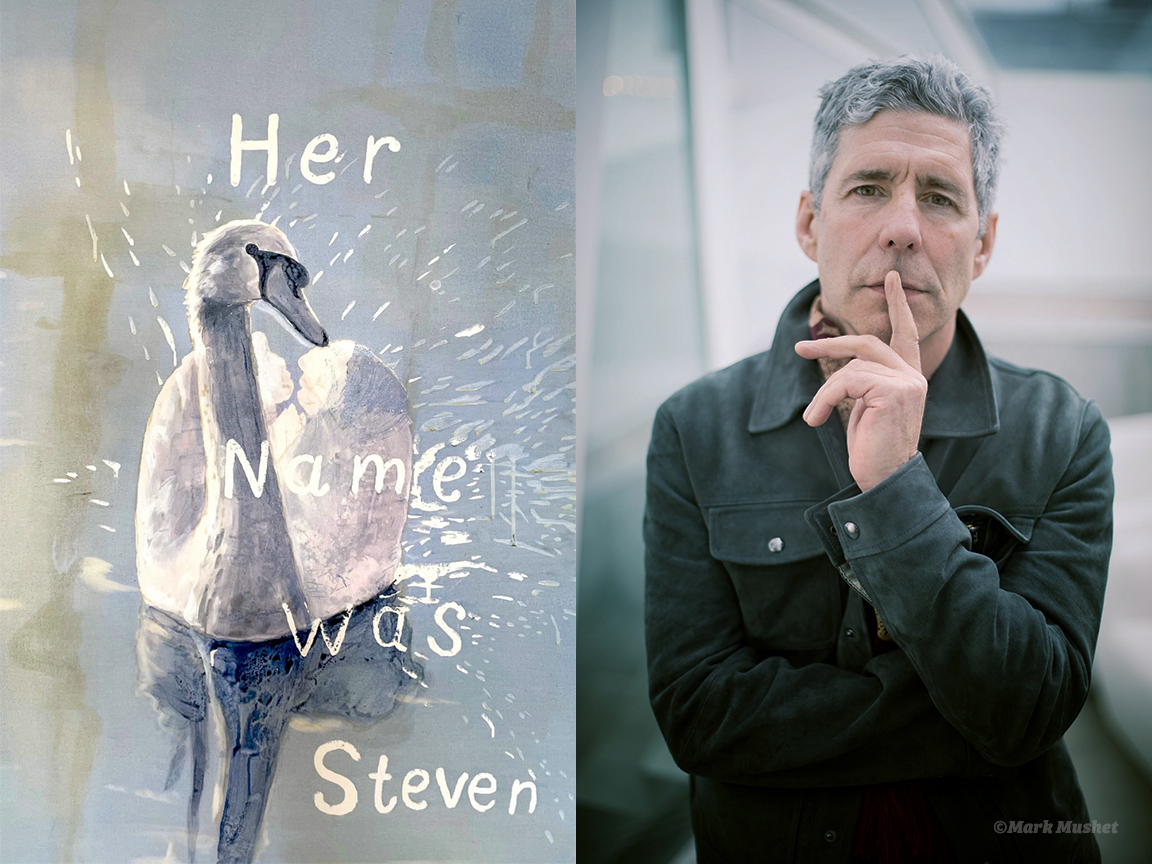
Her Name Was Steven, 2025 (+portrait 2025)
MM: One painting really stuck out at your show at Monte’s last fall. ‘Her Name Was Steven’ features a very conventionally pretty rendering of a swan, striking in its simplicity and elegance. The swan is also, of course, quite loaded in terms of literary and art historical terms. Can you talk about the origin this piece?
GG: ‘Her Name was Steven’ is the name of a CNN documentary which explores the life of a transgender woman. This phrase stuck with me for years. When I found the image of the swan, I knew it was a provocative fit. “Her Name Was Steven” led to another image/text painting. In this one, the transition was from female to male: the swan was replaced with a fire-breathing dragon head. It was captioned with the phrase “His Name Was Sara”. Humour has always played a central role. Not quite ‘joke’ paintings, but images and words which the viewer has to unpack. Is Graham being serious here? Or is he using satire to reveal the elitism of art and of the intellect? David Foster Wallace’s novel, ‘Infinite Jest’ comes to mind. I’m also interested in trying to debunk the idea that the purpose of painting is to express deep emotional feelings. Give me Jasper Johns over Mark Rothko any day.
Here are some ideas on ‘Steven’ which I wrote a while back: Within the work is a tendency to express change or uncertainty through language that itself exhibits those qualities. ‘His Name Was Sara’ and ‘Her Name was Steven’ operate within this interchange, suggesting a before-and-after fluidity. In other works, such as ‘Committal/Noncommittal’, heterogeneous forms try to adapt to each other. They speak different languages and struggle with social anxiety. Despite their anatomical differences, Steven and Sara want to survive, coexist and rejoice in their new-found identities.
MM: It seems you take inspiration from many seemingly random places and take your time in developing ideas.
GG: Coming up with an idea: Maybe the search for an idea is the idea. I’ve always found the phrase itself odd. “Having” an idea, as though it’s an object you might misplace, like your keys. Do we have ideas, or do they have us? Do they exist before we think them, waiting somewhere to be discovered?
MM: Economics aside, what would be your dream project, one that will likely never be realized?
GG: A friend suggested once that I should “go big”. My visual language, he said, was perfect for digital projections on buildings…in Las Vegas no less! This is the last thing I am interested in. I’m still committed to the rectangle, to the paint. Painting may be the last medium which is non-digital. I like being alone in my studio, the intimacy, the turning inward. To paint well, you must shut the door and turn off your phone. I’m grateful that I missed the technology train. When I was in art school, all we had were magazines to see what was going on in the Art world: Flash Art, Art Forum, Art in America. I remember coming across a tiny black and white photograph of a painting by Terry Winters. It changed everything.
MM: You’re writing now, in addition to the painting.
GG: I’m trying to write fiction these days. Writing is even harder than painting. It takes a few seconds to look at a painting. Some people don’t have the time and attention span to read a novel. The short story is the painting. A novel is the museum show. I’m thinking about the relationship between writing and painting- the ways in which these mediums access different realms within the same world. A simple word painting, say using a short phrase, or a single well-chosen word is good at reducing an idea down to the essence of a thing. There’s more specificity with writing. It can grapple with the big questions…Painting is something else. Painting, by comparison, is kind of a cop-out. What you’re doing is primarily solving aesthetic problems. With writing, there is morality involved. It gives more access to the human condition. There are exceptions- I think of Picasso’s Guernica and the horror of war…We tend to use that example a lot.
Lately, with writing, I’ve been playing with a seemingly banal set of circumstances and taking it to an extreme, even absurd level. It often has to do with relationships between people.
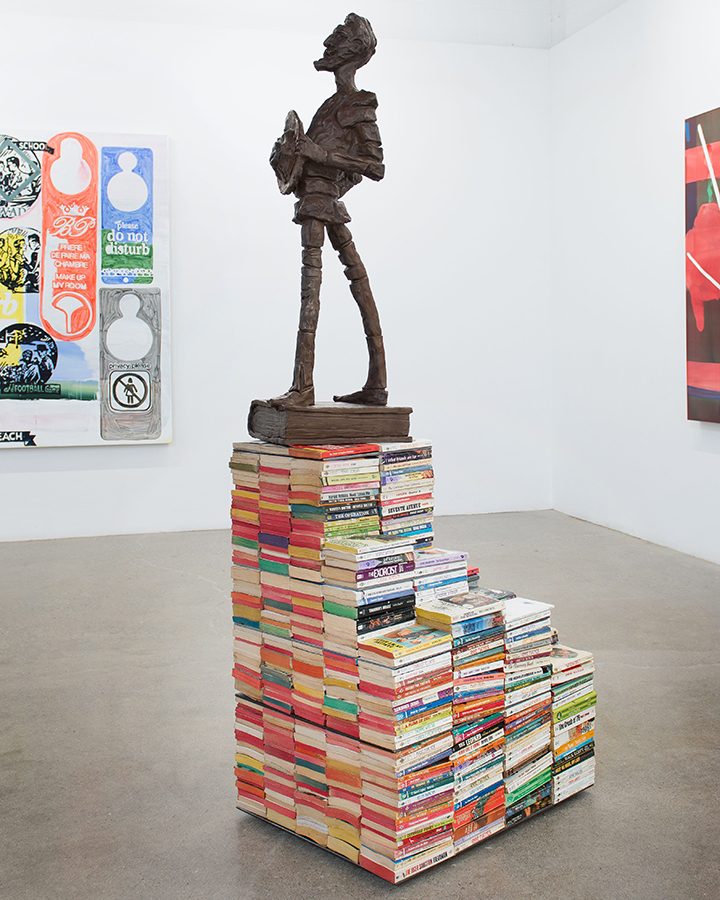
Quixote, Bronze Resin, books, 2011
Don Quixote still holds a certain relevance to this day. Reality versus illusion, what is real and what is virtual. The base of the bronze statue I did is in the form of a book. This book is not real – it’s a representation of a book. The statue sits on top of a stack several hundred Harlequin Romance novels. Those are real books! He is being both propped up by these fictional romances as well as conquering them. If you look closely at the hat he’s holding, you can see that I took a bite out of the clay, which finished the piece. At one point in Cervantes’ novel he tries to eat his hat, thinking that it’s a loaf of bread.
(Ed. note: suggest new painting title: “Wilting at Tindmills”)
MM: There was some controversy a few years ago over the decision to move the Monte Clark and Equinox Galleries from their once very prime and unified location on “The Flats” (the old Finning factory site) in front of Emily Carr University to accommodate a new development. Certain painters supported the move suggesting that it was unfair and intimidating to have art students face commercial gallery spaces the second they exit the building. I could not understand this. And for using the word “coddle” to describe a desire to shield art students from facing two galleries that welcomed all who entered (and who came to rep many ECU grads over the years) I was painted as “the voice of the patriarchy” (seriously) on Facebook. “Coddle” is apparently now a trigger word to get you dismissed. The sad irony was that the painter attacking me was repped by the only commercial gallery in town that I ever felt repelled by the second I entered, where I felt intense snobbery and disinterest. Oh, well, at least there’s still a brewery nearby.
GG: When we (Futura Bold) attended ECCAD (81-85) a big influence was our instructor, Bill Featherston. We would walk down to Bridges, a bar on Granville Island, for beers in the afternoon. He was our friend and advisor, sharing stories of his experience as a professional artist: gallery representation, sales strategies, how to remain truthful to your vision. Also, how to deal with the more nefarious underbelly of the industry. Basically, everything art school didn’t teach us at that time. To protect Bill Featherson’s upstanding reputation, I won’t reveal any of his tactics here.
MM: A parting thought on the nature of ideas and creation?
I read a quote by Alan Watts recently. “…Try to embrace all of life, even the parts that destroy you.” Maybe it’s better to be genuinely human than falsely divine.
Perhaps you can mention that I have a book of short stories coming out next year titled ‘The Tales We Spin For Love.’
MM: I will…
One place you can peruse Graham’s more recent work is at Monte Clark’s site. There are several works that appeared in the fall, 2025 exhibit and there’s a path to discovering more.
https://monteclarkgallery.com/graham-gillmore-artist/